


For Jenny
As National Glioblastoma Day approaches in June, alongside the anniversary of our dear friend and coworker Jenny’s passing, I found myself returning to her story with a level of clarity and understanding I did not yet possess when we first lost her. Jenny was more than a colleague and leader at Oklahoma Proton Center. She was someone whose presence quietly shaped the culture around her through attentiveness, generosity, and an uncommon ability to make people feel seen.
After her diagnosis with glioblastoma, she faced her illness with a kind of honesty that revealed both the limitations of language and the profound importance of simply remaining present for one another. This reflection is not only about grief, but about the enduring imprint people leave behind in the lives and systems they help shape. It is also a recognition of the patients and families living with glioblastoma today, and a reminder of why continued awareness, compassion, and support remain so important.

We have built an entire vocabulary to manage the unbearable.
It is precise, carefully calibrated, and widely shared. In medicine, in grief, in everyday life, we reach for phrases that promise orientation: We’re hopeful. We’ll take this one step at a time. Quality of life.
These are not empty expressions. They are tools. They allow us to proceed when clarity is impossible. But they are also, at times, a kind of scaffolding. Language that holds us up when the structure beneath us has already shifted.
What they cannot do is change the nature of what is happening.
I learned this in the most direct way through a colleague named Jenny.
When I first began working at the Proton Center, Jenny was the Vice President of Clinical Operations. She had come up through the field as a dosimetrist, a role that requires both technical rigor and an intimate understanding of how cancer moves through the body. It is work that demands precision, but also proximity to suffering.
Jenny carried both.
She had been diagnosed with salivary gland cancer at a young age and survived it. That experience did not make her exceptional in the way people sometimes narrate survival. It made her attentive. She did not speak about illness as an abstraction. She understood its texture.
At work, this translated into a particular kind of leadership. She included people in rooms they might not otherwise have entered. She paid attention to small shifts in others—who was struggling, who was overlooked, who needed to be pulled closer. Her authority did not rely on distance. It came from presence.
This is important, because when her own illness came, it did not arrive as an unfamiliar category.
It arrived as something she already understood.
The early symptoms were easy to misinterpret. They often are. There is a long cultural habit of assuming that serious illness will announce itself clearly, that it will distinguish itself from the ordinary inconveniences of the body. It rarely does.
But eventually, there was a diagnosis: glioblastoma.
Jenny saw it herself on the scan. She knew what she was looking at.
That moment, the act of seeing, matters more than anything that followed. Because once you understand what you are looking at, language loses its mediating function. There is no longer a need to translate reality into something more tolerable.
There is only recognition.
We often talk about the importance of “good communication” in medicine, as if the right combination of words can meaningfully alter the experience of illness. But there are thresholds beyond which communication does not clarify, it simply accompanies.
There is nothing you can say into that kind of knowing that makes it easier.
Over the next fifteen months or so, Jenny lived inside that reality. What stands out is not a singular display of courage, but something subtle: the sustained act of remaining. Continuing where she could. Letting go, gradually, of what she could not.
At one point, after the chemotherapy made her lose her hair, I helped fit her for a wig.
This is the kind of moment that invites language. It asks for reassurance, for small fictions that make change feel manageable. We stood in front of a mirror, adjusting them, evaluating them.
They did not work.
We both knew it immediately.
There was an opening, brief but familiar where one of us could have stepped in and said what is expected. That it looked good! That it would be fine! That this, too, could be normalized.
Instead, we laughed.
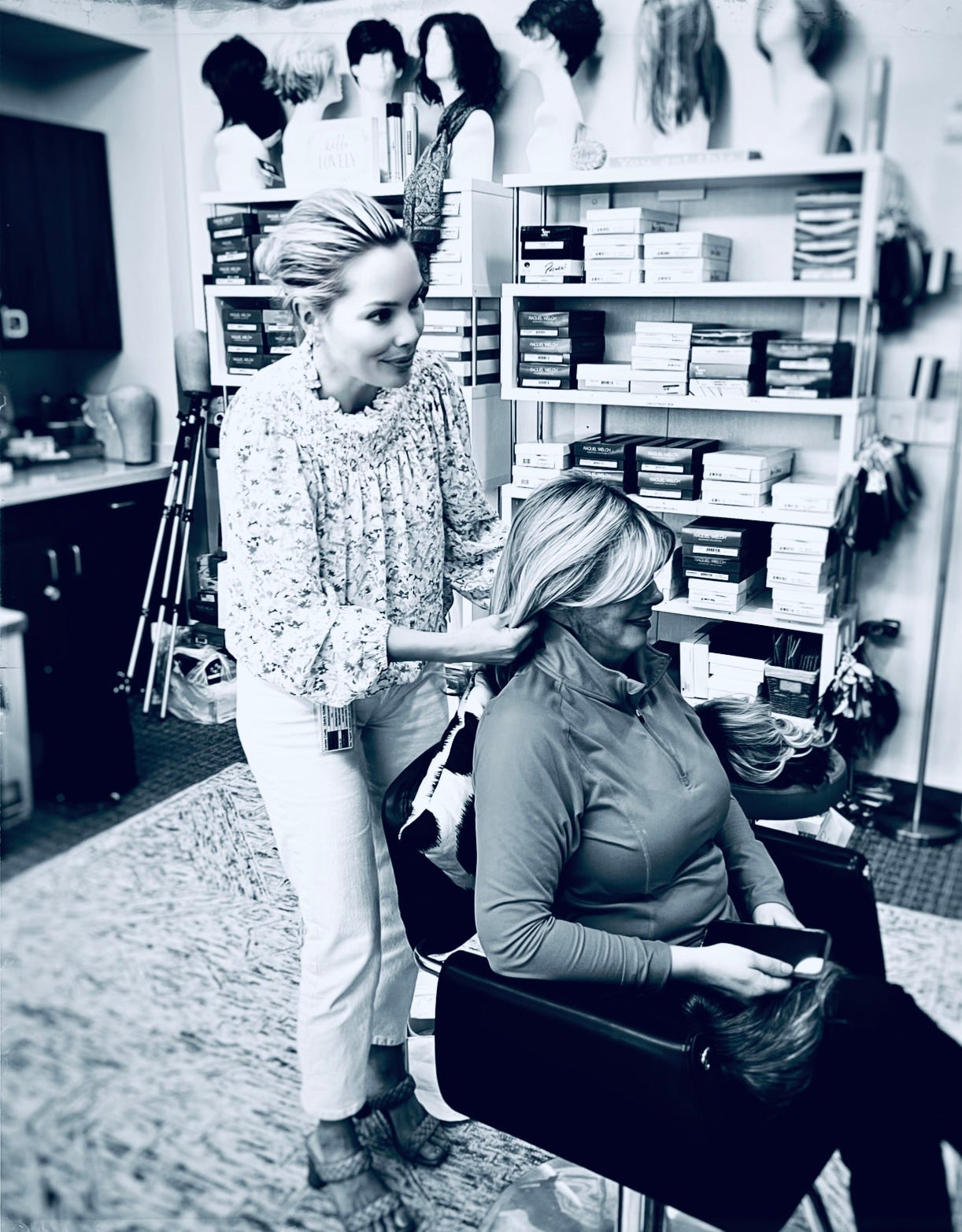
Not because it was humorous, exactly, but because it was accurate. A shared acknowledgment of reality without the impulse to revise it.
In that moment, the absence of language was not a failure of care. It was a more precise form of it.
The last time I saw Jenny was on a Teams call with our staff. Her daughter spoke on her behalf.
By then, she was too weak to speak. Her presence was mediated through a screen, reduced to an image that carried more meaning than any words could have held. We were dozens of faces, each attempting to locate themselves within the moment.
No one tried to fill the silence.
This, too, is worth noting. Our instinct, in moments of discomfort, is to speak—to stabilize, to interpret, to move things forward. But there are situations in which speaking does not advance understanding. It diminishes it.
We cried.
The writer Joan Didion once described grief as a state in which “there is no real way to deal with everything we lose.” This is often misunderstood as a kind of despair. But it may be closer to a description of reality. Loss does not resolve. It reorganizes.
After Jenny died, Oklahoma Proton Center created an award in her name.
It is given to the employee who best reflects the qualities she embodied: attentiveness, generosity, the instinct to include others. It is, on the surface, a simple act of recognition. But it also raises a more complicated question: what, exactly, is being preserved?
Not her, of course. Not in any literal sense.
What remains is something less tangible but more durable—an imprint on how others behave. The way someone pauses before excluding another person. The decision to make room where it would be easier not to. The quiet replication of a standard that was never formally articulated, but widely understood.
This is the afterlife of a person within a system.
For those who are left behind, grief does not present itself as a singular event. It appears in fragments. In moments when language fails unexpectedly. In habits that persist without their origin. In the recognition that certain ways of being in the world were learned, not innate, and that their source is now gone.
We often frame healing as a return to normalcy, to stability, to a prior state. But grief resists that framing. As Elisabeth Kübler-Ross observed, it is not something that concludes. It is something that integrates.
The question is not how to move on, but how to move forward while carrying what cannot be resolved.
What Jenny’s illness revealed, ultimately, was not just the inadequacy of language, but its proper boundary.
Words can guide us to the edge of experience. They can name, approximate, and sometimes comfort.
But there is a point at which they must give way to something else.
Presence. Recognition. The willingness to remain without explanation.
It is there—beyond language—that we encounter both the full weight of loss and the quiet persistence of what endures.